You reacted before you fully noticed it.
You said something, withdrew, attacked, or started explaining yourself — and only afterward tried to understand why.

WHAT IS THE FORCESMITH MENTAL SYSTEM?
The Forcesmith Mental System is a systems-based framework for self-understanding and mental development that uses engineering logic to map subconscious and automatic processes.
It combines the mindset of debugging and systems analysis from programming with the study of human behavior and solution-focused problem solving.
Not a diagnosis. Not a label. First, understand the process.
BEFORE CONSCIOUS CHOICE
You may have heard the often-repeated online claim that 90–95 percent of our actions are driven by the subconscious. There is no scientific consensus on such a precise percentage. What is widely accepted is that a substantial part of human behavior relies on automatic processes.
You said something, withdrew, attacked, or started explaining yourself — and only afterward tried to understand why.
You do not set the boundary or confront the issue even when it would be appropriate, because you do not want to hurt the other person.
You help, explain, and try again, yet meet the same indifference, resistance, or lack of change.
The more a problem repeats, the more useful it becomes to ask which automatic emotional and behavioral process may be keeping it alive.
A MAP OF HUMAN BEHAVIOR
The system centers on a precisely nameable mechanism: your Self-Sense and your Ego Reflex.
Self-Sense is the inner evaluation system that instantly and subconsciously compares an incoming situation against the patterns shaped by your past experience — deciding, in a moment, whether a situation is good or bad for you, whether it lifts you up or hurts you, whether it feels safe or threatening. The Ego Reflex is the almost-instant, largely subconscious response that follows, before you can consciously think it through.
It offers a functional map of behavior: how emotions, instincts, automatic programs shaped by earlier experiences, and conscious thinking interact.
It does not look at two people as isolated sets of reactions. It examines a process in which one person’s behavior changes the other person’s state, and the response then feeds back into the first person.
Something happens outside you or inside you.
Emotion, physical signal, inner tension.
A familiar automatic response begins.
The reaction becomes an action, words, or silence.
The consequence creates the next situation.
Over time, these interactions can form repeating relational dynamics and behavioral patterns — processes that may become difficult to leave through willpower alone.
WHY IS THIS NECESSARY?
Advice by itself is often not enough:
These can be useful suggestions. But they do not work the same way for every person, in every situation, or for every underlying process.
RECOGNITION
Once the process becomes observable, you no longer see only that “it happened again.” You can begin to see how you got there.
Notice changes in your inner state and the situations, thoughts, and reactions that repeatedly appear together.
Connect the trigger with the emotion, reaction, behavior, and consequence.
Instead of relying only on the automatic program, plan a conscious response that fits the situation.
Try it, watch the consequence, and then adjust or refine the response when necessary.
The goal is for the new behavior to become more than something you must constantly remind yourself to do — and gradually become a learned response available at reaction level.
WHEN SEVERAL PROBLEMS CONNECT
Overthinking. Poor sleep. Low confidence. Decision fatigue. Relationship tension.
If these regularly move together, it may be worth asking whether they are different points in the same feedback loop.
A difficult situation can start overthinking. That can increase tension, disrupt sleep, and reduce decision capacity — so you enter the next situation with less mental energy than before.
PRACTICAL MENTAL TOOLS
Compare your current inner state: mental energy, balance, confidence, and how these values change over time.
Observe a thought as a mental event before automatically carrying it forward into the next link of an internal chain.
Connect the trigger, interpretation, emotion, reaction, behavior, and consequence.
Examine how two people continuously modify one another’s emotional state and behavior through feedback.
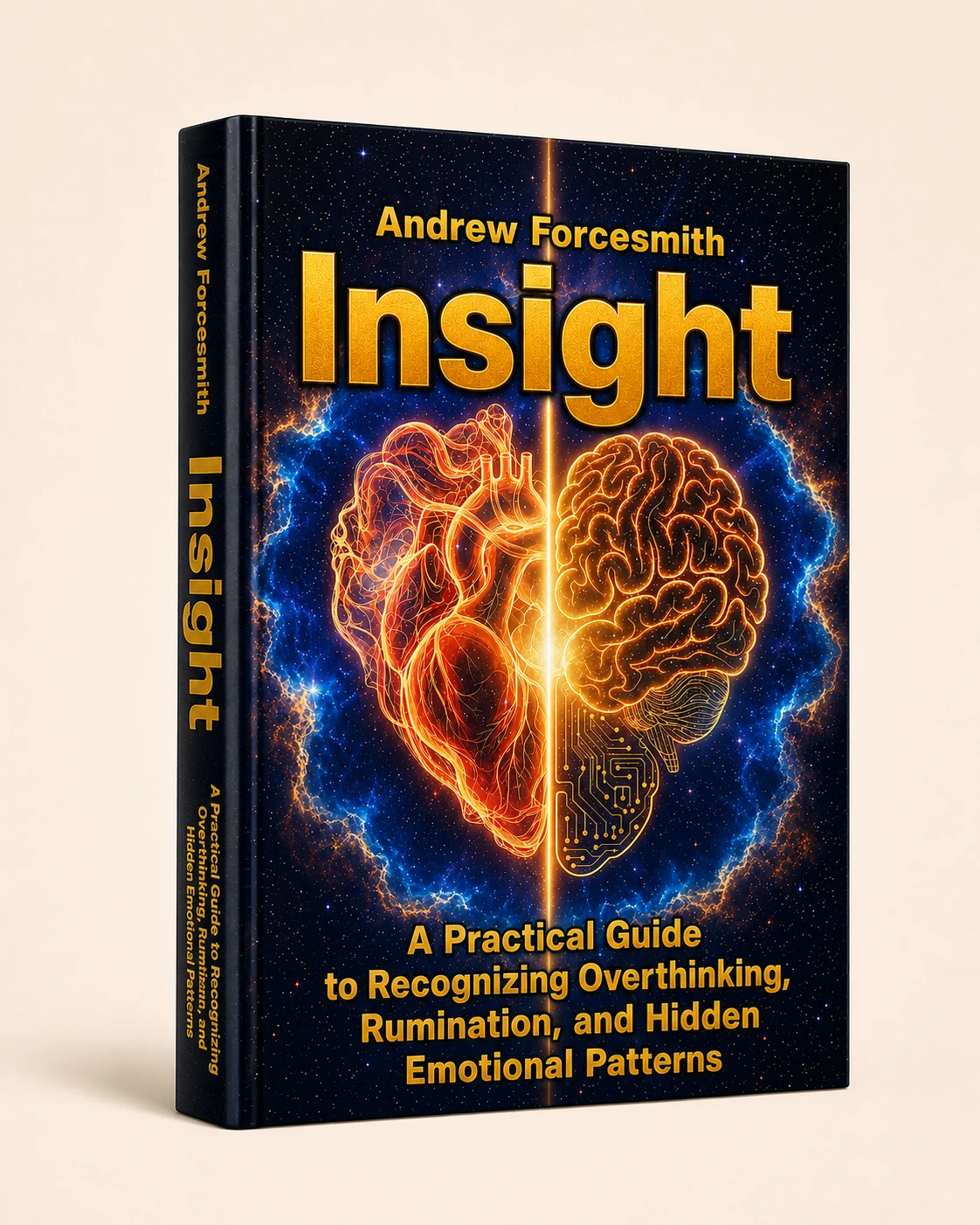
THE STARTING POINT
The Forcesmith Mental System: Insight
A Practical Guide to Recognizing Overthinking, Rumination, and Hidden Emotional Patterns.
The book introduces the foundations of the Forcesmith Mental System: automatic programs, Self-Sense and Ego Reflexes, overthinking loops, relationship dynamics, and the first steps of systems-based self-observation.
“What is happening in me and around me that makes me react this way again and again?”
When we can see the process, we do not have to focus only on the consequence. We can look for the point where the process actually begins.
Explore the approach
THE FORCESMITH PERSPECTIVE
It maps the inner logic that may connect decisions, fears, attachment, avoidance, anger, guilt, the need for approval, overthinking, and recurring relationship patterns.
FAQ
You do not need to accept a new label about yourself. First, simply observe whether a process keeps repeating.
It is a systems-based framework for self-understanding and mental development. It uses an engineering mindset to examine automatic mental, emotional, and behavioral processes, how they influence one another, and how recurring patterns are formed.
Because many reactions begin before we have consciously thought them through. Forcesmith first tries to make the process that triggers the reaction visible, so we are not relying on willpower alone to overwrite the final behavior.
No. We carry different experiences, sensitivities, fears, self-protective reactions, needs for approval, and defensive patterns. Forcesmith therefore offers a map for understanding your own process rather than a universal recipe.
No. It is an educational, self-observation, and mental development system. It does not diagnose mental disorders and does not replace medical, psychiatric, or psychotherapeutic care.
Start with recognition. Notice which situations, emotional states, thoughts, and reactions repeatedly appear together. First understand the process; then decide where and how to change it deliberately.
THE NEXT QUESTION
Ask first: “What is happening in me and around me that makes me react this way again and again?”
Discover the Forcesmith Mental System